Use cases
What actually lives in an area?
Not according to policy or assumptions, but in reality.
Eco-moni makes biodiversity measurable: continuously, objectively, and scalably. With smart sensors in the field that automatically read, analyze, and interpret observations. This way, fieldwork isn't replaced, but enhanced.
With more and better data, continuous measurement, rapidly scalable and self-thinking.

Attendance
detection
Knowing what's going on
Habitat spaces arise in all sorts of ways. Sometimes they're deliberately designed, often they just happen - in eaves, cavity walls, or perpend joints.
With presence detection, Eco-moni shows if and when a nest box is actually being used. As soon as activity is detected, insights are generated - not as a snapshot, but continuously over time. And it's easily expandable to include sensors for microclimate measurement.
Without disturbing the environment and without repeated field visits, continuous monitoring reveals what's actually happening. This makes ecological measures more substantiated and accountability for policy, SMPs, and CSRD concrete and factual.
No assumptions, but current information from the field.

Bioacoustics
Knowing what types of birds there are
Birds are good indicators of biodiversity. In practice, it often turns out that there are five times as many species present as initially assumed.
With bioacoustic monitoring, Eco-moni continuously tracks bird sounds over time. This creates a complete and objective picture of which species actually occur - not based on assumptions or isolated counts, but on systematic observations.
Without additional fieldwork or disturbance, it becomes clear what's truly happening in an area. These insights form a direct basis for ecological substantiation, area development, and accountability for policy and CSRD.

Digital transect
The digital version of the transect
What do biodiversity measures really do - and what don't they?
With the digital transect, Eco-moni systematically measures changes in biodiversity over time, across an entire site. A baseline measurement serves as the starting point; follow-up measurements reveal which interventions are effective.
We're applying this approach at Schiphol Trade Park, where biodiversity isn't measured in a single location, but across the entire area. This creates patterns instead of isolated observations.
This provides administrators and developers with concrete insight to make adjustments and choices based on what works in practice.
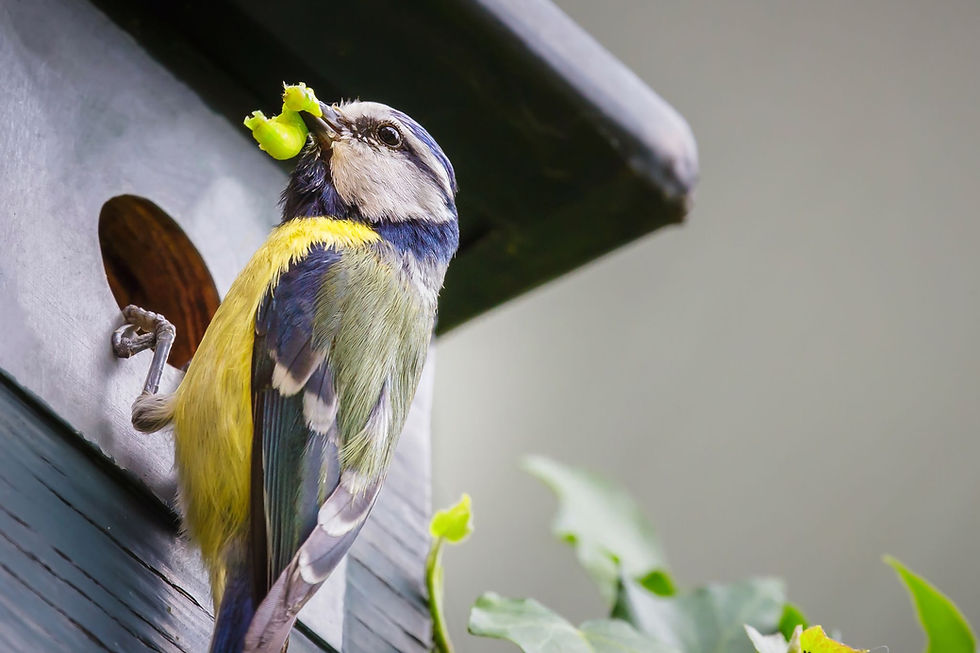
Nest box monitor
What birds eat says something about their habitat
What birds feed their young reveals what's happening in the environment. With NestMoni, Eco-moni visualizes the food parent birds gather, such as insects and caterpillars.
By systematically monitoring this behavior, we gain insight into the local food supply and thus the quality of the habitat. Without disturbance, directly from the nest box.
The data is valuable for ecological analysis, while the images simultaneously provide understandable and appealing content for communication and awareness.

Insect monitoring
Insight into biomass
Insects form the foundation of biodiversity, but are often overlooked. Yet, they determine what's possible for birds, mammals, and plants in an area.
With automated insect monitoring, Eco-moni provides continuous visibility into insect populations. Camera measurements and image analysis provide insight into numbers, activity, and changes over time - not as a single count, but as a continuous pattern.
In agricultural settings, this supports targeted and sustainable pest control. In nature and area development, it provides early insight into the ecological status of a site, even before problems surface.
In this way, the basis of biodiversity becomes measurable, discussable and manageable.
